
GPT-6 Sol and Luna for SaaS: Route Workloads, Don't Replace Everything
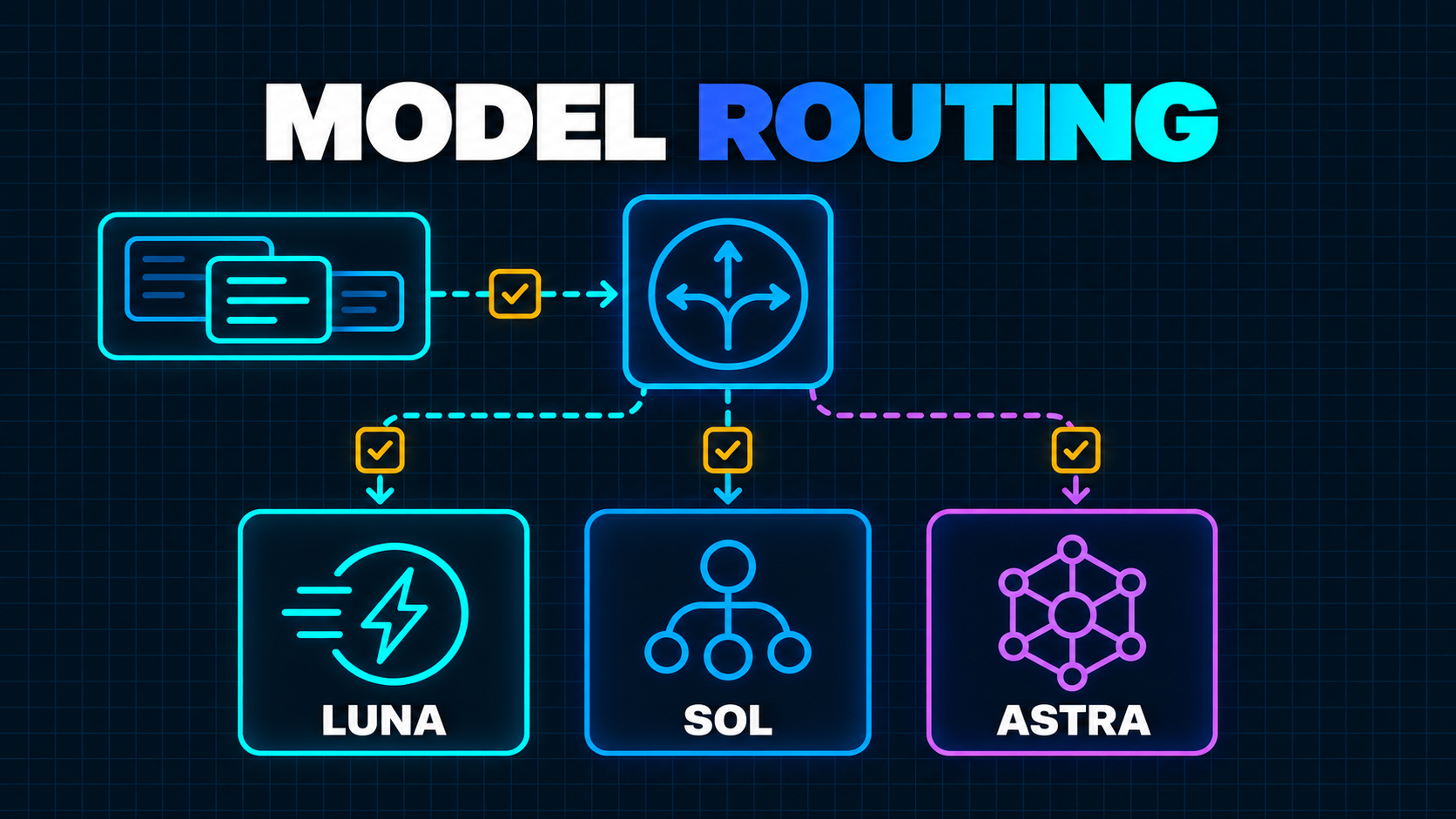
OpenAI released GPT-6 Sol and GPT-6 Luna on September 22, 2026. For a SaaS team, the important change is not that there are two new model IDs to paste into an environment variable.
It is that one model no longer needs to serve every AI workflow in your product.
The official OpenAI API changelog describes both models as accepting text and image inputs and producing text through the Responses and Chat Completions APIs. Sol is positioned as the balance of intelligence and cost; Luna is the efficient option for focused, high-volume work.
That makes model routing a product decision. A support-ticket classifier, a customer-facing report, and an autonomous account-reconciliation workflow do not have the same cost of failure. They should not automatically receive the same model or reasoning budget.
The right rollout is not “replace the old model everywhere.” It is: define task classes, choose the cheapest configuration that clears each class's quality bar, and keep an explicit promotion path for harder cases.
Start With Workload Contracts, Not Model Names
A model router should know what a task is expected to do before it chooses where to send it.
For each AI-powered feature, write a small workload contract:
- What input does the model receive?
- What output shape must it return?
- Can a human review the output before it matters?
- Can the action be reversed?
- Which tools or customer data can it access?
- What happens when confidence is low or validation fails?
- What are the latency and cost budgets for one completed task?
Consider three common SaaS workflows.
Ticket triage reads a subject and message, then returns a category and urgency label. The output is structured, easy to validate, frequent, and usually reversible. This is a reasonable Luna candidate.
Account health summaries combine usage, support, and billing signals into a narrative for a customer-success manager. The work needs judgment, faithful synthesis, and consistent explanation. Sol may be the better starting point.
Contract exception review must compare documents, identify ambiguity, use tools, and explain why a clause needs attention. The cost of a plausible but incomplete answer is higher. This may require Sol with more reasoning or Astra, plus mandatory human review.
These are starting hypotheses, not permanent assignments. OpenAI's model selection guidance similarly frames Luna for scoped tasks, triage, and frequent automations; Sol for everyday work that needs judgment; and Astra for ambiguous, demanding work. It also recommends testing the same inputs and keeping the lightest setting that meets the required quality bar.
Use Three Lanes, Not a Clever Black Box
Early routing logic should be boring enough to audit.
Lane 1: Luna for bounded, repeatable work
Use Luna first when the task has clear inputs, a narrow output schema, and cheap validation. Examples include:
- Classifying feedback into a controlled taxonomy
- Extracting fields from consistent documents
- Rewriting text to a defined length and tone
- Drafting internal summaries that a person will review
- Applying a known transformation to many similar records
Do not send a task to Luna merely because the prompt is short. A four-line request to cancel accounts, change permissions, or issue refunds can have more consequence than a long document summary.
Lane 2: Sol for work that needs judgment
Use Sol when the workflow must combine evidence, make trade-offs, or produce a customer-visible deliverable. Examples include:
- Synthesizing several sources into an account brief
- Drafting a response that must follow nuanced policy
- Reviewing code or configuration changes
- Planning a multi-step workflow with tool calls
- Resolving an ambiguous request against product context
Sol should be the ordinary escalation target, not the automatic default for every request.
Lane 3: Astra for the hardest cases
Reserve Astra for tasks whose ambiguity, breadth, or consequence justifies the stronger model. A complex investigation across tools, an unfamiliar codebase change, or a high-value deliverable with many interacting constraints may belong here.
This lane still needs limits. “Use the best model” is not a safety policy. Keep tool permissions, approval gates, timeouts, and output validation independent from model choice. The model may improve; the consequences of a bad tool call remain yours.
Route on Consequence and Complexity
A useful router can begin with explicit product signals instead of asking another model to guess which model it needs.
type TaskClass =
  | "ticket_classification"
  | "account_summary"
  | "contract_review";

const policy = {
  ticket_classification: {
    model: "gpt-6-luna",
    reasoning: "low",
    humanReview: false,
  },
  account_summary: {
    model: "gpt-6-sol",
    reasoning: "medium",
    humanReview: true,
  },
  contract_review: {
    model: "gpt-6-astra",
    reasoning: "high",
    humanReview: true,
  },
} as const;

export function routeTask(taskClass: TaskClass) {
  return policy[taskClass];
}
The exact mapping should come from your evaluations. The valuable architectural decision is that the product supplies taskClass; free-form user text does not select the expensive or privileged lane directly.
Add routing inputs only when they are stable and explainable:
- Task class
- Customer plan or feature entitlement
- Required output schema
- Tool set
- Maximum acceptable latency
- Consequence tier
- Previous validation failure
Avoid a maze of hidden thresholds. If an engineer cannot explain why a request reached Astra from one trace, the router is already too complex.
Calculate Cost Per Completed Task
Token price matters, but it is not the unit your customer buys.
The current OpenAI pricing page lists Standard short-context rates of $2 input and $10 output per million tokens for GPT-6 Sol, and $0.10 input and $0.50 output for GPT-6 Luna. Cached input has a lower rate, while long-context and other processing tiers have different prices.
Those numbers make Luna attractive for volume, but a cheap first call is not cheap if it frequently needs a Sol retry, manual correction, or a second tool sequence.
Track this instead:
completed task cost =
  first attempt
  + automatic retries
  + escalation calls
  + tool charges
  + review or correction cost
For a hypothetical month with 5 million uncached input tokens and 1 million output tokens, the published Standard short-context token rates would produce a raw model bill of $20 on Sol or $1 on Luna. That is an illustration, not a forecast: real requests may use different token volumes, context tiers, tools, retries, and reasoning behavior.
Measure cost alongside acceptance rate. A route is successful only when it completes the task at the required quality, not when it generates the cheapest response.
Treat Reasoning Effort as Part of the Route
Model choice is only one control. Reasoning effort changes the operating point inside a model family.
OpenAI's current GPT-6 model guidance says Sol and Luna support none, low, medium, high, xhigh, and max, while Astra does not support none. It also recommends the Responses API for tool use; reasoning with tools through Chat Completions has compatibility limits.
Start low for bounded transformations. Increase effort when your evals show that the task benefits from more deliberate reasoning. Do not use maximum effort as a substitute for better context, clearer tools, or a narrower workflow.
A practical order is:
- Improve the task contract and output schema.
- Test a higher reasoning effort on the same model.
- Promote to the next model lane if quality still misses the bar.
- Route to human review when the system cannot establish a safe answer.
That order gives you a traceable explanation for both quality and cost changes.
Build Evals From Real Failure Modes
Do not decide from five polished demo prompts.
Build a small evaluation set for each workload from representative, permission-safe examples. Include ordinary cases, edge cases, adversarial instructions, missing data, conflicting evidence, and inputs that should produce a refusal or request for clarification.
OpenAI's evaluation best-practices guide recommends task-specific evaluation criteria and notes that comparison, classification, and scoring against defined criteria are often more reliable than open-ended judging.
For ticket triage, score exact category, urgency, schema validity, and false escalation rate. For an account summary, score factual grounding, coverage of required signals, unsupported claims, and reviewer acceptance. For a tool-using workflow, score tool selection, argument correctness, permission compliance, final state, and recovery from tool failure.
Run every candidate configuration against the same frozen set:
| Candidate | Quality gate | Operational gate | |---|---|---| | Luna, low | Meets task-specific accuracy and safety bar | Fits latency and cost budget | | Luna, medium | Improves failed cases without new regressions | Added cost is justified | | Sol, low or medium | Clears judgment-heavy cases | Escalation rate remains bounded | | Astra | Clears the hardest approved class | Reserved for cases worth the cost |
Do not average away severe failures. A configuration that succeeds on 98 routine examples but leaks restricted data on two adversarial examples does not pass.
The broader process in How to Evaluate AI Agents Before Production applies even when the “agent” is only a single structured model call: define the outcome, test failures, and observe production behavior.
Keep Caching Separate From Routing
Routing chooses the model. Prompt caching determines whether repeated prefix work can be reused. They affect cost together, but they solve different problems.
OpenAI's prompt caching documentation says caching is enabled by default for supported models and that reuse depends on a matching prompt prefix. For GPT-5.6 and later models, cache writes and reads have different prices, and the documentation recommends keeping stable instructions and tool definitions before dynamic content.
That suggests two practical rules:
- Keep each route's stable instructions, tool definitions, and examples in a consistent prefix.
- Do not distort the routing policy merely to chase a cache hit.
A Luna request cannot reuse a Sol cache entry as if the models were interchangeable. Track cache efficiency per route, then optimize prompts that repeat often. Keep customer- or workspace-specific cache accounting separated where your billing and privacy model requires it.
Design Escalation Without Duplicate Side Effects
The dangerous version of fallback is “if anything fails, run the whole task again on a stronger model.”
If the first attempt already sent an email, changed a record, or charged a card, replaying the task can repeat the side effect. Escalation must preserve workflow state.
Separate reasoning from execution:
- Ask the model for a structured plan or proposed action.
- Validate schema, permissions, identifiers, and business rules in code.
- Escalate the proposal if confidence or validation is insufficient.
- Execute an approved action once with an idempotency key.
- Record which route proposed and approved the action.
For long-running or tool-using workflows, carry forward verified tool results rather than making the stronger model rediscover the world. Redact data it does not need. A higher model tier should not automatically receive broader permissions.
If you also need provider portability, keep the model policy behind a product-owned interface. The decisions in Make Your AI SaaS Portable are relevant here: prompts, evals, tool contracts, and traces should remain assets you control.
Common Routing Mistakes
Routing by prompt length
Long does not mean difficult, and short does not mean safe. Use task type, ambiguity, and consequence.
Letting users choose the expensive lane
A visible “best model” switch can be a product feature, but it should have entitlement and budget controls. Do not let arbitrary prompt text silently promote itself.
Comparing only answer style
A more confident or polished answer is not necessarily more correct. Score the facts, schema, tool behavior, and completed outcome.
Hiding model changes inside a generic alias
Convenient aliases can make behavior drift difficult to investigate. For critical routes, record the requested model, returned model or snapshot information when available, reasoning setting, prompt version, and router version.
Ignoring residency and processing constraints
Model availability does not guarantee that every processing tier fits your data commitments. The official pricing and model guidance currently note that EU data residency for GPT-6 Sol and Luna is available only with Standard processing. Recheck this before promising a region or latency tier, and review the architecture questions in Regional AI Inference.
A Seven-Step Rollout Plan
- Inventory every AI workflow. Record its input, output, volume, tools, current model, reasoning effort, latency, review path, and consequence of failure.
- Create three consequence tiers. Separate bounded reversible tasks, judgment-heavy customer work, and high-consequence or ambiguous workflows.
- Build representative eval sets. Use real failure patterns, remove sensitive data, and define hard safety gates separately from average quality.
- Benchmark the lightest candidate first. Test Luna and low reasoning on bounded tasks, then increase effort or promote to Sol only where evidence supports it.
- Add explicit escalation. Preserve validated context, prevent duplicate side effects, and make human review a valid terminal route.
- Shadow before switching. Run the candidate route without affecting users, compare outputs, and inspect disagreements on consequential cases.
- Release gradually and watch task economics. Monitor completed-task cost, acceptance, correction, escalation, latency, and safety failures by route and prompt version.
What I Would Do Now
I would not migrate every production call to GPT-6 Sol or Luna this week.
I would choose one high-volume, reversible workflow and test Luna against its current model with a frozen evaluation set. I would choose one judgment-heavy workflow and test Sol. I would keep Astra as an explicit escalation lane for cases whose value and complexity justify it.
Then I would ship the router as versioned product policy: named task classes, explicit model and reasoning settings, observable decisions, and a human route for cases the system should not resolve alone.
Sol and Luna make finer-grained AI economics possible. The durable advantage is not getting onto the newest model fastest. It is building a product that knows which work deserves which level of intelligence—and can prove that the choice still works.
If your AI feature is still a single prompt wired directly to a provider, a focused SaaS MVP development review can turn that experiment into a testable, observable product boundary before model routing becomes another layer of hidden complexity.
Working on a SaaS that's starting to feel fragile?
Talk to an engineer about the parts that break first — without rewriting what already works. We'll recommend focused support or a compact team based on your scope.
Talk to an Engineer