
AI SaaS Fraud Controls: Protect Trials, Payments, and Model Spend
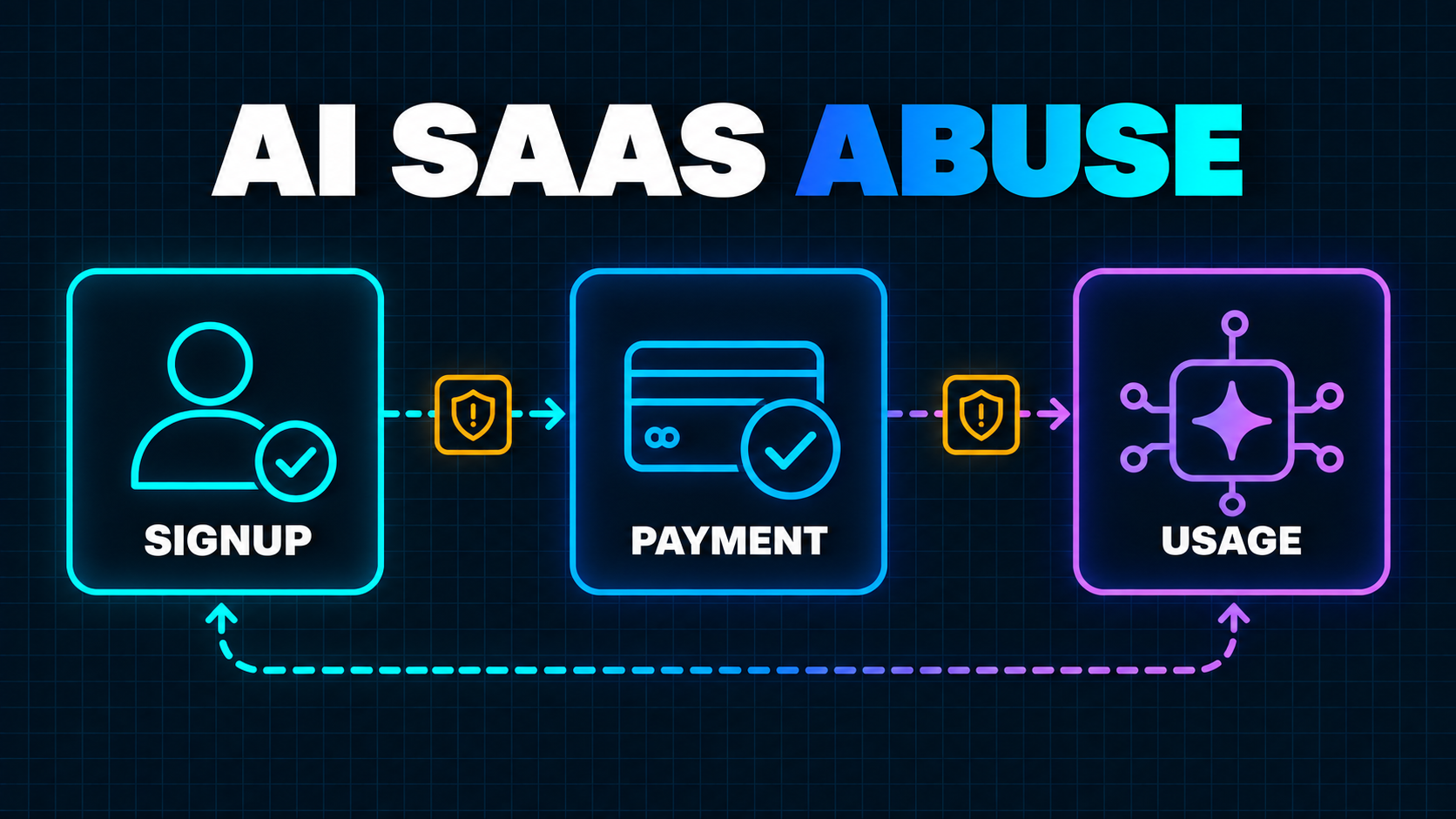
An AI product can lose money before a fraudulent payment is ever attempted.
A person creates several accounts, claims the welcome credits on each one, and sends expensive requests through your product. Another customer pays with a stolen card, consumes the purchased capacity immediately, and leaves you with model costs and a later dispute. A legitimate team shares one credential across an automation fleet, turning a normal subscription into uncontrolled usage.
These look like separate problems. Operationally, they are one problem: your product grants something with real marginal cost before it has enough confidence in the customer.
Stripe's September 2026 analysis gives founders a useful warning. On Stripe, AI startups had an attempted transaction fraud rate 4.3 times the startup average in Q3 2025, falling to 2.6 times by Q1 2026. At the same time, attempted multi-account abuse at AI subscription companies increased 40% from January to June 2026. These are Stripe network observations, not universal industry rates, but the direction matters: abuse moves across the customer lifecycle when one control gets stronger.
The practical response is not to put a CAPTCHA on every screen or block every unusual customer. It is to join signup, payment, entitlement, and usage decisions into one system that limits loss while preserving a good path for legitimate users.
Why AI SaaS changes the fraud equation
Traditional subscription software often has a delay between access and material cost. Adding one more user to a project-management tool may have a small immediate infrastructure impact.
AI products are different. A new account can trigger model inference, web search, image generation, document processing, or a long-running agent within seconds. The user receives the value while the founder receives the bill.
That creates three connected attack surfaces:
| Stage | What the product grants | Common abuse | Business loss | | --- | --- | --- | --- | | Signup | Trial credits or limited access | Multi-account creation | Compute cost and polluted acquisition data | | Payment | Subscription or prepaid balance | Stolen cards and card testing | Disputes, fees, and consumed capacity | | Usage | Model calls, exports, agents, API access | Credential sharing or automated draining | Provider spend, degraded service, and resale |
Payment fraud tooling helps at the middle stage. It cannot, by itself, decide whether five apparently different accounts represent one person, whether a paid account is being resold, or whether one request can launch an unexpectedly costly workflow.
OWASP's anti-automation guidance makes the same architectural point: login, signup, checkout, and public APIs have different threats and need different first controls. It recommends threat-modeling each endpoint, using layered signals, and responding progressively instead of treating every bot as malicious (OWASP Bot Management and Anti-Automation Cheat Sheet).
Start by defining the unit of value
Before selecting a fraud product, write down what an attacker can obtain.
"Free trial" is too vague. A trial might grant 20 chat messages, 10 minutes of audio, one generated report, an API key, or access to an agent that can spend several dollars on tools. Two features with the same marketing value can have very different loss limits.
For every expensive action, record:
- The maximum provider cost of one request
- Whether the action can run concurrently
- Whether a retry can repeat paid work
- Whether output can be resold or transferred
- Whether the action touches customer-connected tools
- Which identity, workspace, and payment state authorized it
This inventory becomes your abuse budget. If a single unverified account can launch 100 concurrent research agents, your largest risk is not a weak CAPTCHA. It is an entitlement design that grants too much value at once.
The same discipline applies to model choice. A small classification call and a deep multi-tool investigation should not share one undifferentiated quota. The routing approach in GPT-6 Sol and Luna for SaaS is useful here: classify work by consequence and complexity, then attach limits to each route.
Make signup earn trust in small steps
The goal at signup is not to prove a person's legal identity. It is to avoid giving a new, low-confidence account a large transferable benefit.
A reasonable first-session design might allow a user to complete one useful workflow, save a result, and understand the product. It should not immediately allow bulk API access, high-concurrency generation, or large exports.
Increase trust as the account adds credible signals:
- Email verification unlocks a small trial allocation.
- A completed profile or workspace setup unlocks another product step.
- A successful payment increases limits, but does not remove all controls.
- Account age and normal usage history increase concurrency gradually.
- Manual review or a sales process unlocks unusually expensive capabilities.
Do not make one signal carry the whole decision. IP addresses are shared. Virtual cards have legitimate uses. Privacy tools are not proof of fraud. Corporate users may sign in from multiple countries. A blanket block creates false positives and trains support staff to bypass controls casually.
Instead, combine account velocity, verified contact points, payment relationships, device continuity, request patterns, and prior product history. Store the reasons behind a decision so support can explain and safely reverse it.
Stripe's earlier analysis found that suspected multi-account abuse affected 7.4% of AI-company signups in its dataset and noted that self-serve AI startups offering trials and direct API access saw much more attempted abuse than enterprise AI products. It also explains why blocking all virtual cards is a poor shortcut: legitimate customers use them for security and spending control (Stripe's first-party fraud analysis).
Treat credits as a ledger, not a counter
A single credits_remaining field is easy to build and hard to reconcile.
Use an append-only entitlement ledger with explicit events such as trial_granted, usage_reserved, usage_settled, reservation_released, purchase_added, and refund_reversed. Each event should carry an idempotency key, account and workspace IDs, the source of the entitlement, and the related provider operation.
Reserve estimated cost before expensive work starts. Settle the reservation when actual usage is known. Release it if the job fails before value is produced. This prevents concurrent requests from all reading the same balance and overspending it.
For example, if a workspace has 10 units left, two eight-unit jobs must not both start because they observed the balance before either wrote its result.
available = granted - settled - reserved

if estimated_cost > available:
    require_upgrade_or_review()
else:
    reserve(estimated_cost, idempotency_key)
    run_work()
    settle(actual_cost, idempotency_key)
Keep promotional, purchased, and manually granted credits separate. A refund may reverse purchased value without revoking a support credit. A promotion may expire while a paid balance remains. Clear provenance lets you apply the right rule instead of guessing later.
Separate payment approval from resource release
A successful authorization means the issuer accepted a payment. It does not mean the customer is permanently trustworthy, and it does not mean you should release unlimited compute immediately.
Stripe documents distinct outcomes for normal, elevated, high, not-evaluated, and unknown payment risk. Its rules can allow, block, review, or request 3D Secure depending on the payment object and configuration. Stripe also states that merchants remain responsible for accepted payments that are later disputed (Stripe Radar transaction risk prevention).
Translate those outcomes into product entitlements:
- Normal payment plus established account: release the purchased allocation normally.
- Normal payment plus brand-new account: release in tranches as value is consumed.
- Elevated risk: hold high-cost exports or API access while allowing low-cost exploration.
- High risk or blocked: do not provision value; show a recoverable payment path.
- Unknown evaluation: fail safely for expensive work and retry the risk check without duplicating the charge.
This is a product decision layer, not a second payment processor. It consumes payment outcomes alongside account and usage context.
Also test the negative paths. Stripe provides test payment methods for high-risk, blocked, elevated-risk, free-trial-abuse, and 3D Secure scenarios. Use them to confirm that a blocked payment does not grant credits, an elevated payment reaches the intended review path, and retries do not provision twice (Stripe testing documentation).
Enforce cost controls at execution time
Signup rules become stale. Payment decisions miss later credential theft. Every costly job therefore needs an execution-time check.
The check should answer:
- Is this identity allowed to run this action?
- Does the workspace own enough available entitlement?
- Is the requested concurrency appropriate for its trust tier?
- Has recent behavior changed sharply?
- What is the maximum loss if the estimate is wrong?
- Can the job be stopped after a budget is reached?
Put the decision close to the expensive operation, not only in the browser. A client-side disabled button does not protect an API. A queue worker should revalidate authorization and reservation state because conditions may change between enqueue and execution.
Apply limits at multiple scopes: request, user, workspace, API key, payment relationship, and product-wide. Provider limits are a final boundary, not your tenant policy. OpenAI's API guidance notes that its limits operate at organization and project levels and explicitly recommends per-user time-window caps or manual review for high-volume access (OpenAI rate-limit guidance). Your product still needs to stop one customer from consuming a shared project allowance.
For agents, add tool budgets as well as token budgets. Ten cheap model calls can trigger one expensive search, browser, or media operation. Record both predicted and actual cost by step so the system can stop before the overall workflow crosses its ceiling.
Respond progressively instead of only blocking
Binary allow-or-block logic creates two bad outcomes: attackers learn the exact boundary, and legitimate customers hit a dead end.
Use a response ladder:
- Reduce burst concurrency.
- Delay or queue unusually expensive work.
- Require email re-verification or step-up authentication.
- Require a valid payment method or a small prepaid balance.
- Disable transferable features such as API keys or bulk export.
- Route the account to review.
- Suspend only when evidence is strong or exposure is unacceptable.
The response should match the value at risk. Asking for a payment method before one costly generation may be reasonable. Demanding identity documents for a low-cost writing assistant probably is not.
Give support staff bounded tools: add a temporary allowance, restore a mistaken block, or request another verification step. Log every override with an expiry and reason. Permanent allowlists turn one support decision into an invisible security exception.
Measure loss, friction, and product health together
An abuse system that only reports blocks will drift toward unnecessary friction. Track three groups of measures:
Loss signals: suspicious credits consumed, disputed payments, provider spend tied to later-blocked accounts, duplicate promotion claims, and negative balances.
Customer friction: verification completion, false-positive appeals, payment recovery, time in review, and conversion by risk response.
System behavior: reservation mismatches, duplicated ledger events, jobs exceeding estimate, queue bursts, and decisions made with missing risk data.
Connect the decision ID from signup through payment, credit events, jobs, model calls, and support actions. That makes an incident reconstructable. The minimum telemetry pattern in Minimum Viable Observability for SaaS applies directly: logs explain the decision, metrics show the trend, and traces connect one customer workflow across services.
Do not train rules on contaminated analytics. Multi-account abuse can inflate signup totals, distort activation cohorts, and make a promotion look successful while it is losing money. Maintain a filtered business view alongside raw events.
A seven-step implementation plan
You do not need a dedicated fraud team to improve the architecture. Start with the paths that can lose the most money.
- Map value. List every free, prepaid, and postpaid benefit with its maximum per-request and per-day cost.
- Set a loss ceiling. Decide how much an unverified account, verified account, and new payer can consume before another check.
- Create the ledger. Add reservations, settlement, idempotency, and clear credit provenance.
- Join decisions. Pass account trust, payment outcome, entitlement, and recent usage into one server-side policy check.
- Add progressive responses. Prefer throttling, step-up verification, and limited capability before blanket suspension.
- Test adversarial paths. Simulate parallel requests, blocked and disputed payments, shared credentials, retries, provider timeouts, and support overrides.
- Review weekly. Compare prevented loss with customer friction, then adjust limits with documented reasons.
Start with a small rule set that your team can explain. A complicated score with no decision history is harder to operate than conservative limits, a clean ledger, and a reliable review queue.
The production-readiness question
Fraud and abuse are not add-ons for an AI SaaS product. They are consequences of the product's economics: valuable compute can be consumed quickly, payment certainty arrives late, and attackers move to whichever stage is easiest.
The durable design is a chain of bounded trust. New accounts receive enough value to evaluate the product. Payments inform access without becoming the only trust signal. Every costly job checks current entitlement and reserves a budget. Observability connects the decision to the spend. Legitimate users get a recovery path when controls are wrong.
That is the same mindset behind a production-ready SaaS MVP: protect the core user journey, make failure visible, and limit the cost of being wrong before growth magnifies it.
Working on a SaaS that's starting to feel fragile?
Talk to an engineer about the parts that break first — without rewriting what already works. We'll recommend focused support or a compact team based on your scope.
Talk to an Engineer