


How Agencies Can Outsource SaaS Development Without Losing Control
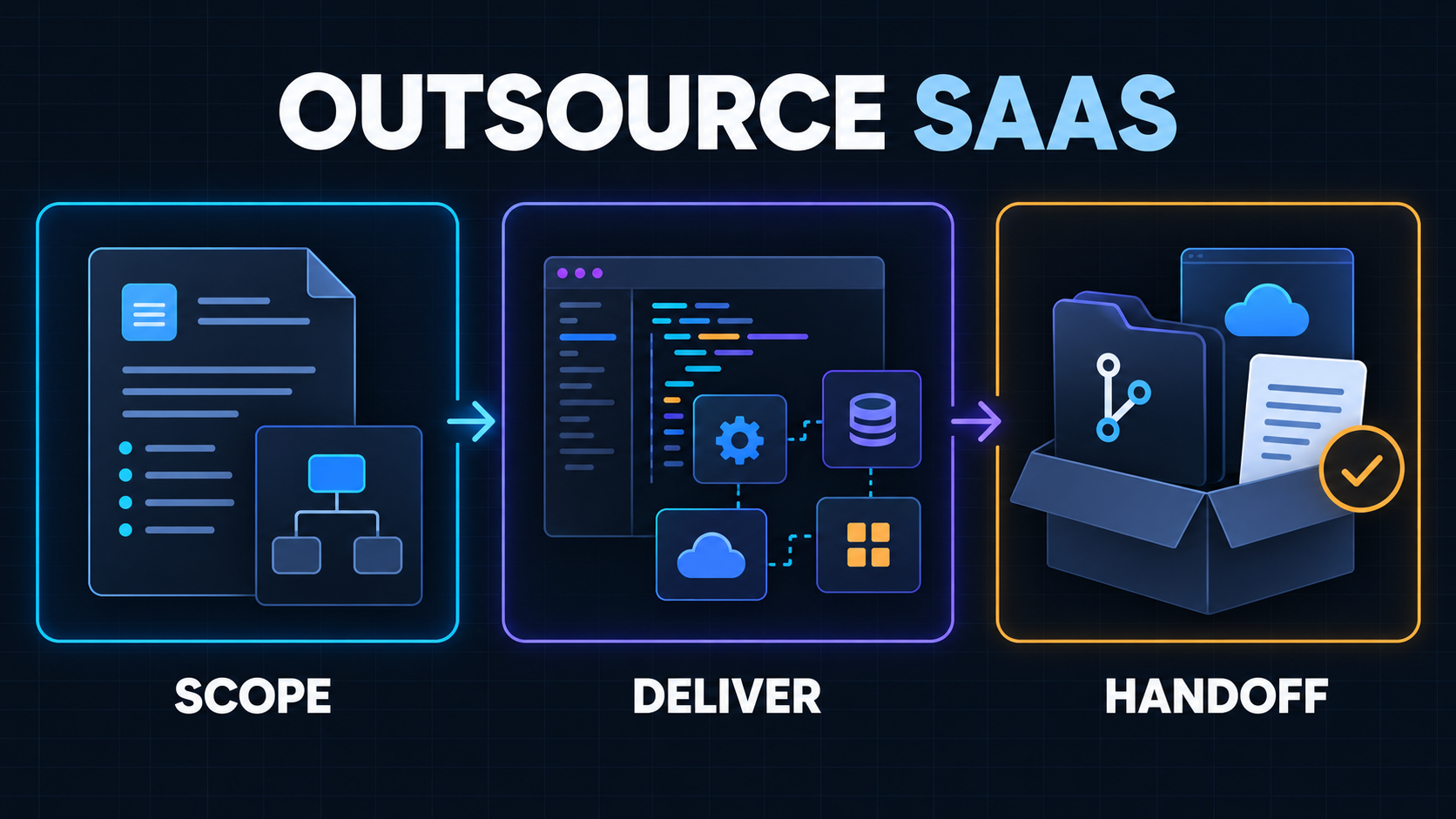
When an agency needs to outsource SaaS development, the difficult part is not finding people who can write code. It is creating a delivery relationship that protects the client promise while another team handles part or all of the engineering.
The agency may own discovery, design, brand, growth, or the client relationship. The development partner may own architecture, implementation, testing, and deployment. If those boundaries remain implicit, both teams can appear busy while the project accumulates gaps: undefined acceptance criteria, inaccessible accounts, duplicated client communication, and a handoff nobody has prepared for.
The right model is not “send requirements and wait for software.” It is a controlled delivery system with one accountable owner for each decision, visible increments, and a planned exit from the first week.
This guide covers how an agency can select a partner, structure scope, retain delivery control, communicate with the client, and receive a maintainable product at handoff. It is a partner-selection and delivery-governance guide; a later guide in this series will address white-label branding, NDA, and support operations in more depth.
Decide What You Are Actually Outsourcing
“Build the app” is not a usable boundary. A SaaS project combines product decisions, engineering work, operational ownership, and client communication. Split those responsibilities before asking for estimates.
An agency can outsource one of three shapes of work:
A bounded capability
The partner delivers a defined subsystem such as authentication, billing, an admin portal, or an integration. This works when interfaces and acceptance criteria already exist and someone on the agency side can integrate the result.
An engineering workstream
The partner owns continuous implementation while the agency owns product direction, design, and client approval. This needs a shared backlog, release process, and technical decision record. It is not staff augmentation without accountability; the workstream still needs an owner.
End-to-end product delivery
The partner helps reduce scope, chooses an appropriate architecture, builds the core workflow, deploys it, and supports launch. This is closer to a technical partnership than a ticket queue. The agency must decide which product and client decisions it retains and which the partner can make without waiting.
If the scope is still uncertain, start with discovery instead of pretending uncertainty is a fixed-price specification. Map the main user journey, risky assumptions, external integrations, data sensitivity, and launch conditions. That creates a smaller, more honest unit to estimate.
For a founder-facing view of these trade-offs, How to Hire a SaaS MVP Developer explains why product judgment matters alongside implementation skill.
Create a Responsibility Map Before a Statement of Work
A strong statement of work describes more than features. It makes responsibility testable.
For each workstream, name one accountable owner and the people who contribute or approve. Cover at least:
- product scope and backlog priority;
- UX and visual approval;
- architecture and technical decisions;
- security and privacy requirements;
- repository, cloud, domain, database, and vendor accounts;
- test strategy and acceptance;
- releases, incident response, and rollback;
- client status, risk escalation, and change approval;
- documentation, training, and handoff.
Avoid shared accountability such as “both teams own QA.” Shared work is normal; shared accountability makes it unclear who decides whether a release is ready. One party can author tests, another can perform acceptance, and both can review defects, but the final decision must have a name.
The scope should also define exclusions. If data migration, accessibility testing, content entry, native mobile work, or post-launch support is outside the engagement, say so. An exclusion is not a hidden caveat; it is an input to the agency’s complete client plan.
Select for the Risks You Need the Partner to Own
A polished portfolio proves presentation, not delivery fit. Evaluate the team against the risks in this project.
Ask who will perform the work, not only who attends the sales call. Review one or two relevant systems at an architectural level: what was the core workflow, what constraints shaped the design, how were changes released, and what did the team document for the next maintainer? Confidentiality may limit specifics, but the reasoning should still be coherent.
Then test these areas:
Scope judgment
Give the candidate your proposed first release and ask what they would remove, defer, or validate manually. A partner who treats every request as mandatory will not protect the timeline or budget.
Delivery visibility
Ask to see the intended working rhythm: backlog, demo environment, pull-request flow, decision log, risk register, and weekly status format. Progress should be observable in working software and repository history, not inferred from a percentage in a slide.
Secure development
Ask how the team turns security requirements into implementation and verification work. The NIST Secure Software Development Framework provides a common vocabulary that purchasers and suppliers can use when discussing secure development. You do not need to demand every control from every small project, but you should be able to trace relevant requirements through design, code review, testing, release, and remediation.
Operations and handoff
Ask who creates deployment environments, monitors failures, handles secrets, rehearses rollback, and writes the runbook. A partner who can build but cannot explain how the service will be operated is delivering an incomplete SaaS product.
Communication under pressure
Ask for an example of how the team reports a missed assumption, security concern, or schedule risk. The useful answer is a process: surface it early, explain impact and options, name the decision owner, record the decision, and update scope or schedule. “We work harder” is not a risk-management method.
Use a Small, Evidence-Producing First Engagement
Before a long build, use a paid discovery or a representative technical slice that creates assets you can keep. It might produce:
- a clarified scope and acceptance criteria;
- an architecture outline and data-flow diagram;
- a risk and dependency register;
- a walking skeleton deployed to a non-production environment;
- a delivery plan with explicit assumptions;
- a handoff checklist and account map.
Do not use unpaid speculative work to judge a production partner. It encourages surface-level output and gives neither party enough access to understand the real constraints.
Illustrative evaluation model: an agency might score candidates from 1 to 5 across scope judgment, relevant technical depth, delivery visibility, security practice, handoff readiness, and commercial fit. Weight the categories according to the project’s risk. The numbers organize a decision; they are not an industry benchmark or a substitute for references and evidence.
Keep the Agency in Control of the Delivery System
Control does not require the agency to approve every technical choice. It means the agency and client are never locked out of their product.
Create the source repository in an organization controlled by the agency or client. Give the partner the minimum role required for its work. GitHub documents distinct repository roles and recommends choosing the role that fits the person’s function without granting more access than needed in its repository roles guidance.
Apply the same principle to:
- cloud and hosting organizations;
- domain and DNS providers;
- production databases and backups;
- email and notification vendors;
- analytics, error tracking, and monitoring;
- payment, identity, and file-storage services;
- design source files and project documentation.
Do not let a partner’s personal account become the only owner of a business-critical resource. Use named organizational accounts, multi-factor authentication, recoverable billing access, and an access register. Review that register during onboarding, role changes, and offboarding.
Repository ownership alone is not enough. The agency also needs build instructions, environment-variable names, migration steps, deployment configuration, third-party dependencies, and current operational contacts. A repository that only one departing engineer can run is not a usable handoff.
Put Ownership and Data Duties in Writing
Code ownership is a contract question, not an assumption created by payment. The UK government’s business guidance warns that paying a supplier does not automatically transfer intellectual-property rights and recommends stating how existing and newly created IP may be owned and used in the contract: Managing intellectual property when working with others.
Have qualified counsel adapt the agreement for the relevant jurisdictions. The commercial terms should address:
- background IP each party brings into the project;
- ownership or licensing of new code, designs, documentation, and data models;
- use and disclosure of open-source and third-party components;
- confidentiality and permitted portfolio use;
- subcontractors and flow-down obligations;
- access to work in progress if the engagement ends;
- payment, acceptance, warranties, liability, and dispute handling;
- termination assistance and deletion or return of client data.
If the partner processes personal data for the agency or client, determine the actual controller and processor roles. The UK ICO states that controllers must assess whether a processor provides sufficient guarantees and put the required terms and documented instructions in place; its controller and processor guidance also makes clear that oversight continues after selection. Applicable rules depend on jurisdiction and data flow, so treat this as an issue to verify, not generic legal boilerplate.
Design a Client Communication Model That Avoids Triangles
The client should know how delivery is governed, even when the development partner is not client-facing.
Choose one model deliberately:
Agency-led communication
The agency remains the single client interface. The partner supplies written updates, demos, risks, and technical explanations to the agency. This preserves a simple client relationship but requires the agency to translate accurately and escalate quickly.
Joint delivery meetings
The agency leads scope and relationship decisions while the partner joins technical reviews or demos. This reduces translation loss. Introduce roles clearly so the partner does not accidentally accept client scope changes outside the agreed process.
In either model, send one shared status view containing completed outcomes, the current demo link, decisions needed, risks, scope changes, and the next checkpoint. Separate facts from forecasts. “Authentication is deployed to staging” is a fact; “billing should be complete next week” is a forecast with assumptions.
The agency should never hide a material risk to preserve the appearance of control. Good governance means making the problem understandable while there are still options.
Make Acceptance About Outcomes, Not Activity
Milestones should be accepted against evidence. A feature is not complete because development hours were spent or a branch exists.
For each milestone, define:
- the user outcome;
- supported roles and permissions;
- important edge and failure cases;
- test and review evidence;
- security or privacy conditions;
- the environment where it can be evaluated;
- required documentation;
- the named approver and review window.
Keep change control proportionate. A small project may need only a written decision in the shared tracker: requested change, reason, impact, options, and approval. The purpose is not bureaucracy. It is preventing a casual client request from silently changing cost, delivery date, or technical risk.
The NCSC supplier-relationship guidance treats supplier security as a lifecycle: due diligence before selection, contractual controls, monitoring during delivery, incident management, and regaining control of assets at termination. That same lifecycle mindset is useful for the wider delivery relationship.
Plan the Handoff While the Product Is Being Built
Handoff is not a final meeting. It is the gradual removal of dependency on undocumented knowledge.
Maintain these artifacts as part of delivery:
- A current architecture and data-flow overview.
- Local setup, test, build, and deployment instructions.
- Environment and vendor inventory without secrets in documents.
- Database schema and migration procedure.
- Monitoring, alert, backup, restore, and rollback runbooks.
- Known limitations, accepted risks, and deferred work.
- Access and ownership register.
- Open-source and commercial dependency notes.
- Support boundaries, response process, and warranty terms.
Before final acceptance, have someone other than the primary partner engineer use the documentation to set up the project or perform a safe deployment rehearsal. Gaps discovered during that exercise are handoff work, not optional polish.
If the product must be stable for real users, compare the result with What Makes a SaaS MVP Production-Ready. If the agency also needs help deciding which technical decisions should stay internal, When a Founder Needs a Technical Partner provides a useful role comparison.
How to Outsource SaaS Development: An Agency Checklist
Before selection:
- define the outsourced outcome and retained responsibilities;
- identify data, integration, security, and delivery risks;
- evaluate the actual team with relevant evidence;
- agree the communication and escalation model;
- confirm account, source, IP, and data ownership terms.
During delivery:
- keep work in agency- or client-controlled systems;
- review working software on a regular cadence;
- record decisions, assumptions, risks, and changes;
- accept milestones against user outcomes and evidence;
- update documentation and the access register continuously.
Before handoff or exit:
- verify deployment, rollback, backup, and restore procedures;
- transfer or remove every account and credential as appropriate;
- review code, tests, dependencies, migrations, and known risks;
- confirm IP assignment or licence obligations have been completed;
- run a documentation-based setup or operational rehearsal;
- agree the support boundary after acceptance.
Frequently Asked Questions
What should an agency outsource in a SaaS project?
Outsource a clearly bounded outcome with agreed interfaces, acceptance criteria, dependencies, and ownership. Keep client strategy, approval authority, and relationship management explicit inside the agency.
Who should own the code and cloud accounts?
The contract should state who owns new and existing intellectual property. In most client-delivery arrangements, the client or agency should control the repository, cloud, domain, data, and other business-critical accounts.
How do you evaluate a SaaS development partner?
Evaluate the actual delivery team using a paid discovery or representative technical exercise, then verify its scope judgment, communication, security process, account ownership, testing, deployment, and handoff plan.
Related Reading
- How to Hire a SaaS MVP Developer
- When a Founder Needs a Technical Partner
- What Makes a SaaS MVP Production-Ready
Next Step
If your agency has a client brief but needs engineering ownership from scope through launch, prepare the core user journey, constraints, designs, integrations, target date, and current technical assets. Then review SomSite’s SaaS MVP development service and agency development partnership model to decide whether the delivery boundary and working rhythm fit your client engagement.
Working on a SaaS that's starting to feel fragile?
Talk to an engineer about the parts that break first — without rewriting what already works. We'll recommend focused support or a compact team based on your scope.
Talk to an Engineer