Why Most SaaS MVPs Fail After Launch (And How to Avoid It)
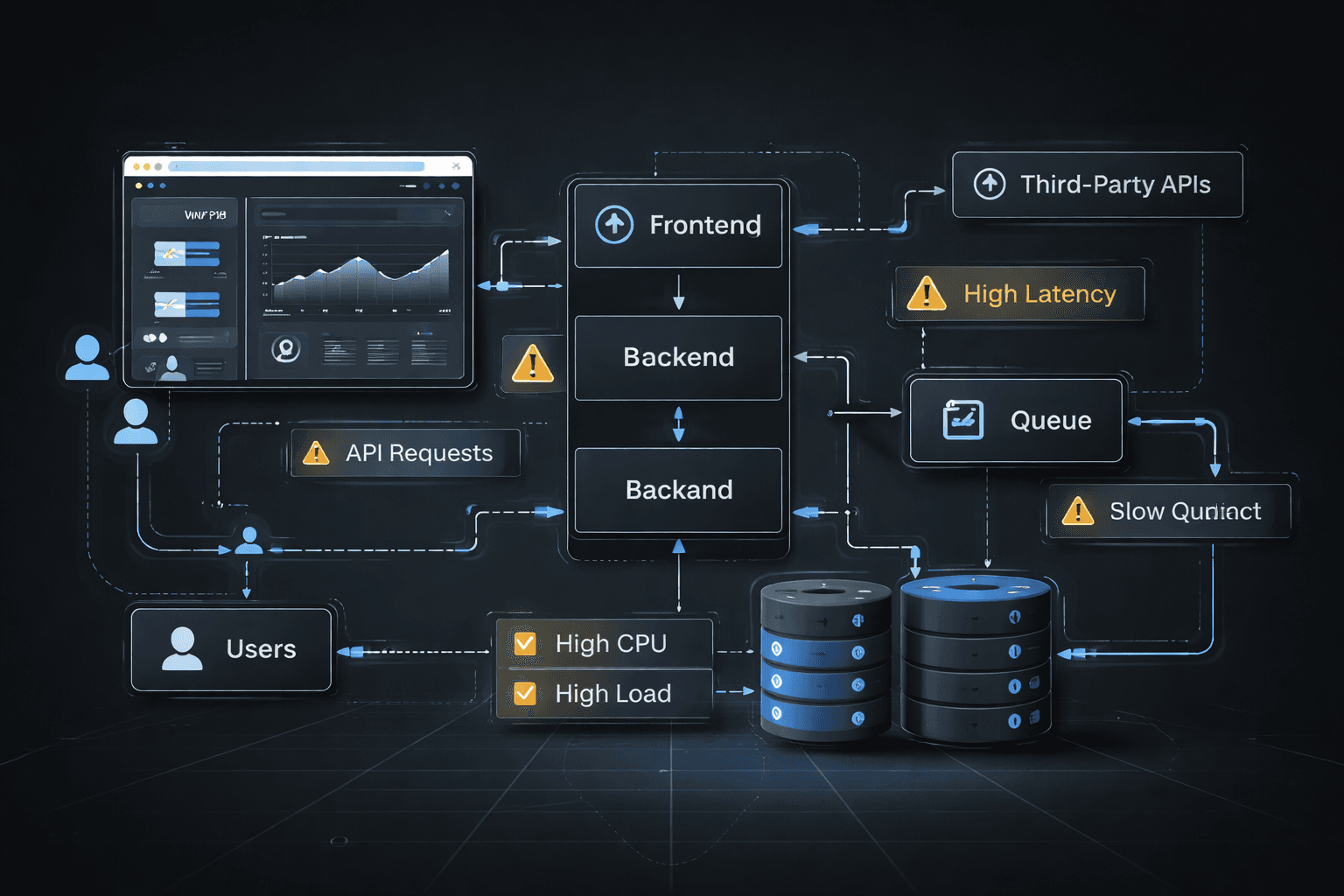
Most SaaS MVPs don't fail because the market rejects the idea. They fail because technical debt outpaces user growth.
In the early days, speed is the only god you worship. Ship fast. Launch fast. Validate fast. But "fast" often means fragile. And when real users start pushing real data through your "temporary" solutions, the cracks don't just appear—they shatter the product experience.
Here is exactly what breaks when you move from prototype to production — and what to do instead.
1. The “It Works on My Laptop” Architecture
Many MVPs are built with:
- No clear separation of business logic
- Tight coupling between frontend and backend
- No thought given to future feature expansion
- Quick database decisions without modeling relationships properly
It works for 50 users.
But once you hit:
- Multiple user roles
- Payment flows
- Reporting requirements
- Automation features
The codebase starts fighting you.
A useful early test: can you describe who owns each piece of data, and what another customer must never see? If not, authorization debt is already forming.
2. Database Decisions That Age Poorly
One of the biggest scaling mistakes is using the wrong database structure for future complexity.
For example:
- Using a document store for deeply relational workflows
- No indexing strategy
- No migration plan
- No data ownership clarity
At MVP stage, it feels flexible.
At growth stage, it becomes technical debt.
A SaaS product is not just CRUD screens — it's evolving business logic. Schema changes get harder after real customers accumulate history you cannot casually wipe.
3. Ignoring Performance Until It Hurts
Performance isn’t just about page speed scores.
It’s about:
- API response times
- Database query efficiency
- Build pipeline speed
- Deployment reliability
I’ve seen teams lose weeks because build times jumped from 3 minutes to 20 minutes as complexity grew.
Small inefficiencies compound quickly. When users complain that “the app feels slow,” you often need targeted work — not a rewrite. See How I Helped Clients Reduce Latency Without Rewrites.
4. Over-Engineering the Wrong Things
Some founders try to “future-proof” everything.
Others ignore structure completely.
The sweet spot is:
- Clean architecture
- Simple abstractions
- Clear domain modeling
- Extensibility without premature complexity
Scalability is not about Kubernetes on day one.
It’s about decisions that won’t break when you grow. That is the same philosophy as boring architecture for SaaS.
5. Auth and Multi-Tenant Boundaries Left for Later
Login is not the same as authorization.
After launch, the expensive failures look like:
- one customer seeing another customer’s records
- admin tools that trust the client
- roles bolted on after the schema solidified
- webhooks and background jobs that ignore tenancy
If you built with AI assistance, audit these boundaries before growth. Related: What to Audit in a Vibe-Coded MVP.
6. The Real Difference Between MVP and Production-Ready
An MVP proves the idea.
A production-ready MVP supports growth.
The difference is:
| MVP | Production-Ready | |-----|------------------| | Fast UI | Structured backend | | Hardcoded flows | Flexible logic | | Manual workarounds | Automated workflows | | Basic schema | Scalable data model |
You don’t need enterprise infrastructure.
But you do need intentional architecture. Full checklist: What Makes a SaaS MVP Production-Ready.
A Practical Rescue Path After Launch
If the product is already live and fragile, avoid the all-or-nothing rewrite unless the codebase truly cannot carry the next six months.
A better sequence:
- Audit — auth, data ownership, deploys, monitoring, hotspots
- Stabilize — fix the failures that create support load
- Structure — boundaries and schemas that unlock the next features
- Accelerate — resume feature work on a calmer foundation
That is exactly what a Production Readiness engagement is for: audit first, then remediation with a senior lead.
What I Do Differently When Building SaaS
When I build SaaS products (for clients or internal projects), I focus on:
- Designing business entities first
- Separating business logic from UI
- Creating modular components
- Keeping performance measurable
- Building for extension, not rewrite
Speed matters.
But structured speed matters more.
Delivery stays senior-led, with specialists added only when scope needs them — so you get direct engineering access without agency handoffs.
Signals You’re Approaching the Failure Zone
Watch for these post-launch signals:
- Every “small feature” touches auth, billing, and the database schema
- Nobody wants to deploy on Fridays
- Support discovers bugs before monitoring does
- Contractors or AI tools keep adding pages without shared domain rules
- The team debates a rewrite more often than the next milestone
One or two signals is normal. A cluster usually means you need a readiness pass before more growth marketing. If you are hiring help, prefer someone who can reduce scope and harden foundations — not someone who only promises more screens. See Hire a SaaS MVP Developer for that framing.
Final Thought
If your SaaS feels brittle after launch, it’s usually not because you need a rewrite.
It’s because early decisions need restructuring.
Refactoring intelligently can extend your product’s lifespan by years.
Working on a SaaS that’s starting to feel slow or hard to extend?
Tell an engineer what is breaking — we can recommend an audit, a remediation sprint, or a focused rebuild of one module.
👉 Production Readiness Upgrade · Talk to an Engineer
Related Reading
- What Makes a SaaS MVP Production-Ready — the bar that separates demos from real products
- 5 Signs Your MVP Is Not Production-Ready — recognizing the warning signs early
- How Much Should a SaaS MVP Cost in 2026? — why the right budget framing prevents these failures
- Why I Prefer Boring Architecture for SaaS — the architectural approach that avoids most of these patterns
Working on a SaaS that's starting to feel fragile?
Talk to an engineer about the parts that break first — without rewriting what already works. We'll recommend focused support or a compact team based on your scope.
Talk to an Engineer