The AI-Era SaaS Playbook: Own One Workflow End to End
AI has made individual software features faster to build and easier to copy. That does not make SaaS irrelevant. It changes what a strong first product must own.
A generic dashboard, form builder or chat box is exposed because customers can replace the feature without changing how their business runs. A product that carries a specific job from intake to outcome is different. It holds the state, decisions, exceptions and handoffs that keep the work moving.
Stripe's September 2026 platform analysis is a useful signal, with an important caveat: it describes businesses on Stripe, not the entire software market. Stripe says new platform businesses on its network were up more than 180% year over year during the preceding three months, while over 55% of new integrations involved some form of AI assistance as of August. It also reported growth in self-serve platforms building more complete integrations. The analysis argues that operational depth, not software scarcity, is becoming the differentiator.
For a founder, the practical lesson is not “build a giant platform.” It is:
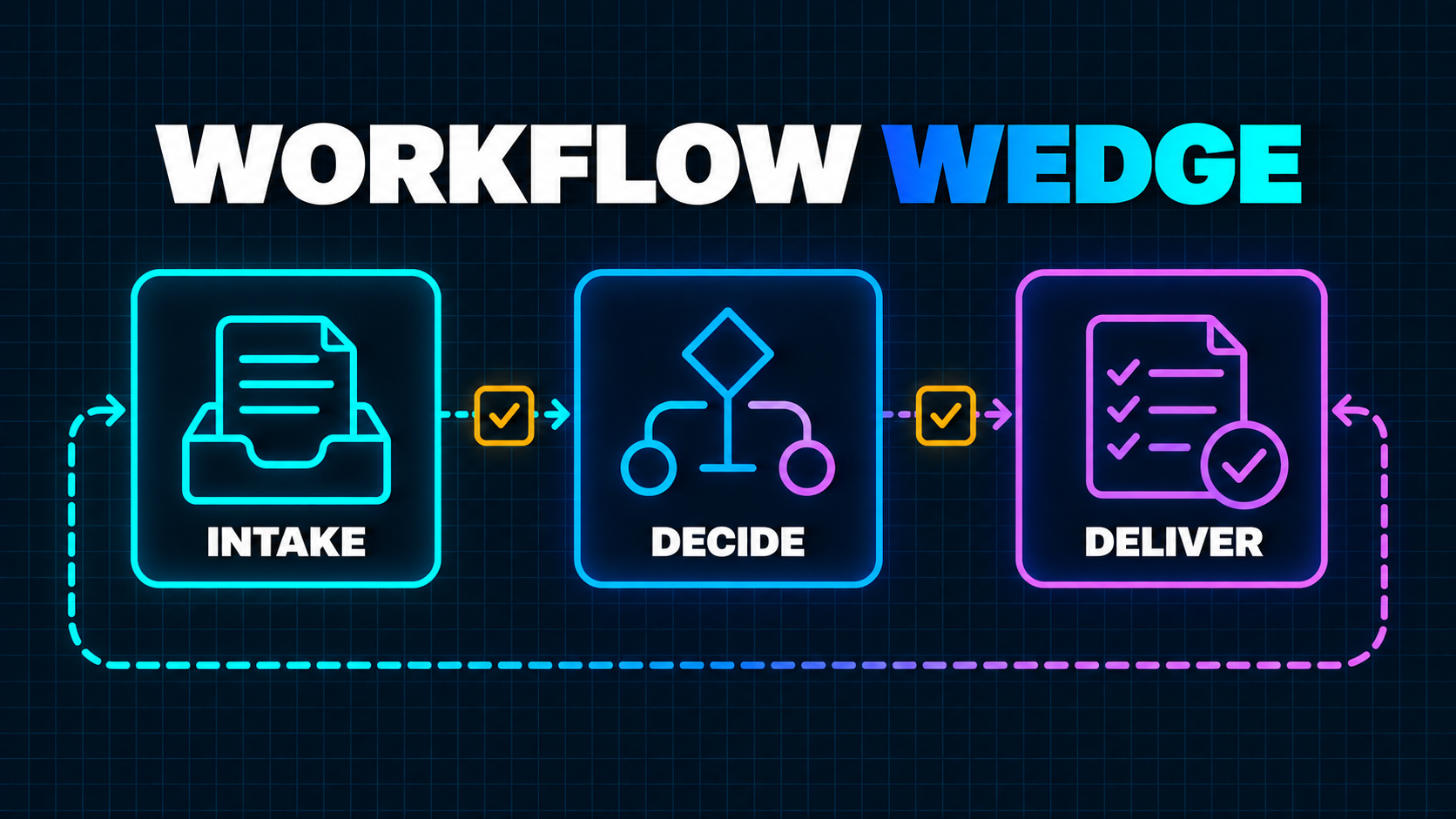
Start with one narrow workflow wedge, own its outcome properly, and expand only after users depend on that path.
What a Workflow Wedge Actually Is
A workflow wedge is the smallest end-to-end job your product can complete for a specific customer.
It is not merely a screen or capability. “AI summarization,” “online payments” and “appointment scheduling” are capabilities. A workflow connects capabilities into a result.
For a small repair business, the wider process might be:
- Receive an enquiry.
- Collect the right job details.
- Decide whether the work is a fit.
- Prepare and approve a quote.
- Schedule the visit.
- Complete the work.
- Issue an invoice.
- Collect and reconcile payment.
An early product should not automate all eight stages. Its wedge might be enquiry to approved booking. That is narrow enough to ship, but complete enough for a customer to feel the outcome.
Compare that with building “a better quote editor.” The editor may be useful, but the customer still has to copy information from email, chase approval, update a calendar and tell the team what changed. The feature saves a few clicks. The workflow removes coordination.
Why Features Alone Are More Exposed
Feature-led MVPs often begin with a technology claim:
- A smarter chatbot
- A prettier dashboard
- Faster document generation
- An AI assistant for a broad profession
- A collection of integrations
These can be ingredients, but none defines the job the product owns.
The problem becomes visible when a founder asks, “What stops another team from adding this?” The honest answer is often: not much. The prompt, component or integration can be replicated. What is harder to reproduce is a product's understanding of the real process:
- Which information is required before work can begin
- Which decision changes the next step
- Who has authority to approve it
- Which exceptions require a person
- Which records must remain consistent
- What counts as a completed outcome
That knowledge accumulates in the domain model, workflow history, integrations, permission boundaries and operating habits around the product. This is why boring architecture can support a more defensible business than a novel stack: the value lives in the workflow, not the infrastructure diagram.
Choose the Wedge Before Choosing the Feature List
Start by observing a job that already happens. A promising wedge usually has five properties.
It Happens Often Enough to Matter
A painful annual task may not create regular product usage. Look for work that happens daily or weekly, or work attached to every customer, order, case, project or transaction.
Frequency is not the same as volume. A weekly payroll approval can still be critical because delay has an immediate consequence. The useful question is: does this workflow repeatedly earn a place in the customer's operating rhythm?
It Has a Clear Beginning and End
“Manage operations” is too broad. “Turn a qualified enquiry into a scheduled job” has an entry condition and a completed state.
Clear boundaries make the MVP testable. You can measure how many eligible items enter the workflow, how many finish, how long completion takes and where a person intervenes.
The Current Process Crosses Tools or People
Strong wedges often hide in the gaps between email, spreadsheets, messaging apps, calendars and payment systems. Each tool may work, but the customer becomes the integration layer.
Map every copy-and-paste step, status question, reminder and reconciliation task. Those handoffs are often more valuable than another standalone editor.
Failure Has a Visible Cost
A missed booking, delayed approval, lost document or unreconciled payment creates a concrete problem. That gives the product a meaningful quality bar and gives the customer a reason to change behavior.
Do not manufacture urgency. Find work where the consequence already exists.
You Can Reach the Outcome Without Owning Everything
The first wedge should integrate with the systems customers already trust. It does not need to replace their accounting suite, CRM, calendar and communication stack on day one.
Owning the workflow means your product knows what should happen next and whether it happened. It does not mean rebuilding every adjacent system.
Model the Workflow as State, Not a Sequence of Screens
Once the wedge is chosen, the architecture should describe the business process directly.
For an enquiry-to-booking product, a record might move through states such as:
received -> needs_information -> ready_for_quote
         -> awaiting_approval -> scheduled
         -> declined | expired
The exact state names are not important. The explicit transitions are.
Each transition should answer:
- What event caused this change?
- Who or what was allowed to cause it?
- What validation had to pass?
- What side effects should happen?
- Can a retry safely run twice?
- What evidence explains the decision later?
This prevents the product from becoming a set of pages that disagree about reality. The browser, API, background worker and integration webhook should all operate on the same workflow state.
Side effects such as sending reminders, generating documents or syncing calendars should run outside the request when they can be retried safely. The SaaS background-jobs guide explains how to make those actions durable without turning a small product into an infrastructure project.
Design the Exception Path Before the Happy Path Feels Finished
The happy path is usually easy to demo. The product becomes operationally valuable when it handles the work that does not fit.
Examples include:
- Required information is missing.
- Two people edit the same record.
- The customer rejects the quote and asks for changes.
- A calendar slot disappears before confirmation.
- An integration times out after the external system accepted the request.
- Payment succeeds but the acknowledgement webhook is delayed.
Do not hide these cases behind a generic “failed” badge. Give the operator a small exception queue with the relevant context and a safe next action.
The first version can keep difficult decisions manual. That is not a product failure. A visible, auditable handoff is better than pretending an immature automation is reliable.
Add AI Where the Workflow Contains Judgment
AI belongs inside the wedge when it resolves ambiguity or reduces unstructured work. It should not be the wedge by itself.
Useful early roles might include:
- Extracting job details from an email or uploaded document
- Classifying an enquiry into a known service type
- Drafting a quote description from structured facts
- Summarizing history before a person approves an exception
- Suggesting the next action when several policies apply
Keep deterministic work deterministic. Totals, permissions, eligibility rules, state transitions and irreversible actions should not become model guesses merely because an LLM is available.
OpenAI's agent-building guide makes a similar distinction: agents are best suited to workflows involving complex judgment, difficult rules or unstructured data; a deterministic solution may be enough when those conditions are absent. It also recommends starting incrementally instead of jumping immediately to complex orchestration. Those criteria are useful even if you use another model provider.
If AI is part of the outcome, define its input, permitted tools, approval boundary and measurable quality. The earlier guide on choosing AI features for SaaS can help decide whether the model improves the workflow or merely decorates it.
Add Payments Only When Money Is Part of the Job
Embedded payments can deepen a workflow, but they also introduce support, risk, reconciliation and compliance responsibilities. Add them because customers already move money at that stage—not because “platform” sounds more valuable than “product.”
Stripe reported in May that median payment adoption among platforms on its network rose from 27% in 2024 to 40% in 2025, while its highest-adoption platforms reached 80% or more. That is vendor data, but the implementation lesson is sound: adoption requires product, go-to-market and customer-success alignment, not only an API integration. Stripe's vertical-SaaS discussion describes payments as an operating workflow rather than a bolt-on feature.
For a booking product, a deposit may naturally confirm the slot. For a repair workflow, an invoice and payout status may close the job. In both cases, money changes the workflow state.
Buy the regulated and commodity layers when possible. Stripe's analysis of its embedded components says platforms use prebuilt flows for onboarding, disputes, payouts and reporting instead of custom-building every financial interface. The useful pattern is to preserve your product's workflow while delegating specialized infrastructure.
Measure Workflow Outcomes, Not Feature Activity
Login counts and button clicks do not prove that the product owns useful work.
Measure the path from entry to outcome:
- Completion rate: What percentage of eligible items reach the intended end state?
- Time to outcome: How long does the workflow take from intake to completion?
- Manual intervention rate: Where must a person rescue or correct the process?
- Exception age: How long do blocked items wait before resolution?
- Rework rate: How often does a completed stage have to be reopened?
- External leakage: At which step do users leave for spreadsheets, messages or another tool?
- Outcome-linked retention: Do customers who complete the workflow repeatedly remain active?
These measures guide the roadmap. If most delay comes from missing intake details, improve intake before adding analytics. If operators leave the product to chase approvals, fix approval and notification flow before adding another AI surface.
A Seven-Step Workflow Wedge Plan
Use this sequence before committing an MVP backlog.
- Interview people doing the work. Ask them to reconstruct the last real case, including messages, spreadsheets, delays and exceptions. Do not ask only what features they want.
- Draw the current workflow. Mark actors, systems, decisions, state changes and handoffs from trigger to outcome.
- Choose one painful boundary. Select a start and end that deliver a recognizable result within one product session or operating cycle.
- Define the canonical record. Decide which state your product owns, what remains in external systems and how conflicts are resolved.
- Ship the happy path with a manual exception queue. Make common work fast while keeping unusual cases visible and recoverable.
- Instrument the outcome. Record completion, elapsed time, intervention, rework and failure reasons before expanding scope.
- Expand one adjacent stage at a time. Add the next step only when it removes a measured handoff or meaningfully improves the existing outcome.
The result should still look like a small MVP. Its depth comes from completing one job properly, not from covering an entire industry with shallow modules.
What Not to Build Yet
Avoid these common expansions until the wedge works:
- A generic dashboard for every possible role
- A no-code workflow designer before one workflow is understood
- A marketplace before supply and demand exist
- Autonomous actions without a reliable exception path
- Custom billing, ledger or identity infrastructure that a mature provider can supply
- Reporting that cannot answer why work is blocked
- Mobile apps, browser extensions and chat interfaces that repeat the same incomplete capability
Breadth can hide the fact that the product does not yet finish anything important.
The Practical Standard for a Strong SaaS MVP
A defensible MVP does not need many features. It needs a clear promise and enough operational depth to keep that promise when reality deviates from the demo.
Choose a workflow customers already perform. Own its critical state. Make exceptions visible. Integrate with systems that should remain systems of record. Use AI for ambiguity, rules for certainty and embedded infrastructure for commodity complexity. Then measure whether the outcome becomes faster, more reliable or easier to operate.
That is a stronger foundation than trying to look like a complete platform on launch day. If you are still choosing the first workflow or deciding what should remain manual, a focused SaaS MVP development review can turn the idea into a narrow, testable product boundary before the backlog expands.
Working on a SaaS that's starting to feel fragile?
Talk to an engineer about the parts that break first — without rewriting what already works. We'll recommend focused support or a compact team based on your scope.
Talk to an Engineer